ICE Packs Federal Plaza With Detainees Despite Court Orders, Questions Rule of Law in Lower Manhattan
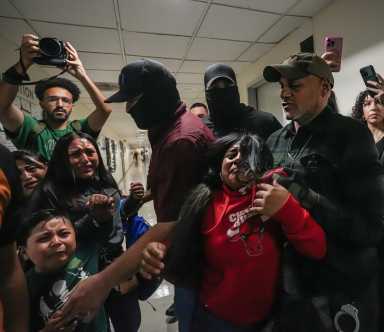
As ICE detentions continue in substandard facilities in the heart of New York City, the city’s vaunted standards of justice and tolerance are being quietly tested.
At 26 Federal Plaza, the bland glass-and-steel mainstay of Lower Manhattan’s courthouse district, a new and troubling chapter in New York’s ever-shifting approach to immigration enforcement is unfolding. Recent admissions by federal attorneys have confirmed what advocates long suspected: dozens of immigrants, many with no criminal record, have been whisked off to detention on multiple office floors within this very building—sometimes plucked from the queue, just steps from their own court hearings.
The government’s decision, unveiled on February 9th, follows the exposure last year of squalid conditions at the site: video footage drew public ire, revealing men sleeping cheek by jowl on the cold floor, forced to share a single toilet. A judge’s order had sought to reduce the number of detainees in these makeshift holding pens, but by all appearances, the Department of Homeland Security, which oversees Immigration and Customs Enforcement (ICE), viewed the issue as one of square footage, not basic decency.
ICE, for its part, maintains that it is simply enforcing the law. Yet by its own data, nearly three-quarters of detainees imprisoned at Federal Plaza—and, indeed, in the broader ICE system—lack any pending criminal charges. The cohort includes young children, families, and people with deep roots in their communities. The agency’s methods contrast starkly with New York’s more tolerant reputation and the city’s self-image as a haven for immigrants.
First-order consequences have manifested quickly. Public defenders and legal advocates say clients now fear to attend the very hearings that are, in theory, meant to clarify their legal status. This portends declining trust not just in ICE but in the judiciary itself. The practice of snatching attendees from courthouse corridors blurs the line between justice and ambush, deterring cooperation with the system at large.
Financially, the city is absorbing knock-on costs. Detention-inspired absences disrupt families and ripple into schools, workplaces, and social services. For the majority of these detainees, the sudden removal from daily life is not a springboard to criminal justice but a blow to economic productivity—a theme that resonates in a city wrestling with slow post-pandemic recovery and persistent labour shortages in hospitality, health care, and construction.
The implications stretch even further. With ICE now seeking to acquire large warehouse-style facilities elsewhere in the United States, New York’s experience looks less like an isolated aberration and more like a preview of a national trend. Compare this to other major cities: Los Angeles, Chicago, and Houston face similar tensions, but New York stands out for the mismatch between the rights it espouses and the realities within its federal buildings. Civil rights groups argue that the metropolis, which has so often led in setting humane standards, now risks falling behind.
Politically, the situation hands ammunition to both sides of an already fevered debate. Migrant advocates invoke past American errors—Japanese internment, family separations at the southern border—warning that each new detention centre or courthouse raid edges the country closer to those dark chapters. Conversely, hardliners point to the “enforcement gap,” bemoaning what they see as urban leniency stoking broader disorder, and urging an expansion of ICE’s remit.
New York’s courts have occasionally tried to nudge ICE toward restraint. The state judiciary and district attorneys, wary of eroding witness cooperation, have publicly requested that federal agents steer clear of courthouses. Yet federal prerogatives—in this case, an elasticity bordering on impunity—once again prevail. The case of Federal Plaza exemplifies a federal-local tension common to many American cities but acutely felt in Gotham, where the stakes of trust and legitimacy run high.
A test for city values and national priorities
The broader context is neither accidental nor fleeting. The Biden administration, having oscillated between rhetorical rebuke and pragmatic enforcement, finds itself presiding over a system built for mass detention but sagging under its own contradictions. Congressional paralysis produces a status quo in which ICE’s annual appropriations—over $8.3bn for 2024—remain lavish by global standards, but oversight is timid and scattershot. The agency’s housing ambitions, now extending to nondescript warehouses far from public scrutiny, evoke a carceral archipelago more attuned to expedience than justice.
Globally, New York’s predicament is far from unique. Across Europe and Asia, cities face tension between cosmopolitan ideals and border anxieties, but New York’s combination of legalistic fervour and bureaucratic opacity is peculiarly American. Detentions in municipal heartlands, under conditions that fall short of local jail standards, would raise eyebrows in London or Paris. Here, they are met with shrugs or, at best, passing outrage.
The choices facing New York are stark. Do city and state officials push for a realignment of federal behaviour, at the risk of costly legal wrangling? Or do they accept, by silence or inertia, that tolerance and due process will be confined to official pronouncements, not lived experiences? The betting, given the city’s bristling politics and intermittent activism, is for a muddle—one distinguished neither by effective resistance nor by unequivocal compliance.
If history teaches us anything, it is that bureaucratic overreach, especially where vulnerable populations are concerned, rarely subsides of its own accord. Only public scrutiny—bolstered by facts, not sentiment—can check the encroachment of expediency. And only continued debate, however tiresome, can ensure that New York’s public squares are not overshadowed by windowless holding rooms, invisible to all but those unlucky enough to enter.
The city that styled itself as a beacon for “your tired, your poor, your huddled masses” now finds its shine in need of burnishing. Whether it can rise to the occasion—or whether ICE’s practices portend a more permanent dimming—remains to be seen. ■
Based on reporting from amNewYork; additional analysis and context by Borough Brief.