QueensWay Park Finally Breaks Ground, Promises Greenspace and Small Business Boost in Central Queens
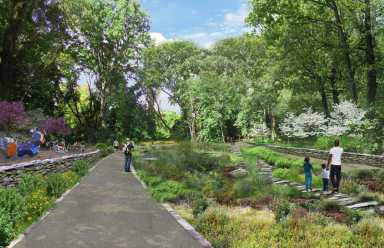
Queens’s new QueensWay park could ease a stubborn civic deficiency in green space while bolstering neighbourhood economies—if the city’s ambitions endure beyond the first shovels of dirt.
It is a mark of New York’s perverse abundance that Queens, the city’s largest borough by landmass and certainly its most kaleidoscopic in ethnic composition, remains so notably starved for green respite. Of the city’s twenty least park-filled neighbourhoods, thirteen—nearly two-thirds—are found in Queens, according to the Trust for Public Land. For 2.3 million Queens residents (to say nothing of their lungs or tempers), the absence is conspicuous, if not galling.
That may at last begin to change. After years of dithering, the city is stepping forward with the QueensWay: a proposed 3.5-mile linear park along a long-abandoned railway corridor in Central Queens. The $100m plan—which kicks off with the “Metropolitan Hub,” a five-acre park and 0.3-mile greenway, this year—seeks to transform rusting tracks into a tree-lined artery, threading together six neighbourhoods otherwise separated by asphalt and accident-prone intersections.
The park promises, as most such projects do, a surfeit of advantages: new recreational space within a mile of nearly 245,000 city dwellers; safer routes for 28 proximate schools and two Little League fields; a verdant route for cyclists and stroller-pushers avoiding the tyranny of traffic. For Central Queens, whose residents have long watched as Manhattan and Brooklyn’s park boons skipped them by, it smacks of overdue justice.
First-order benefits abound. The proximity to so many schools creates opportunities for outdoor education and lunchtime play, a pleasant alternative to tarmac recesses. Community groups eye the corridor for events, fitness activities and cultural festivals. Safe, well-maintained greenways may also serve as informal crime deterrents, as Jane Jacobs once hypothesised, simply by putting more eyes—of every ethnicity—on the street.
The economic ramifications are not trivial. Queens is famously a mosaic of small, plucky immigrant-owned businesses: sari shops and taquerias, halal butchers and dumpling joints. The QueensWay’s multi-neighbourhood connector could bring streams of new customers to storefronts along Metropolitan, Jamaica and Rockaway Avenues, whose fortunes rise and fall with foot traffic more than finance. Research on similar park projects—think Atlanta’s BeltLine or Manhattan’s High Line—supports the notion that greenery begets greenbacks, though it can portend gentrification as well.
There are public health benefits, too. An analysis by the Trust for Public Land suggests that citywide, over one million residents who use parks for exercise contribute to about $1.14 billion in annual healthcare savings. Investing in “active transportation”—infrastructure that favours walking and cycling over driving—could gradually dampen obesity rates and, less glamorously, trim city outlays on road repair and congestion mitigation. That kind of tepid, unglamorous arithmetic reliably wins budget battles—even in New York.
But linear parks are rarely panaceas
For all its promise, the QueensWay will not single-handedly remedy Queens’s green deficit. Even after completion (a date that, in true city form, remains unscheduled), the park’s reach will be puny relative to need. Over a dozen districts in the borough will still scramble for ballfields, tree cover and safe playgrounds. Maintenance, the stormcloud that lingers over all such projects, could turn a gem into an overgrown liability if Parks Department funding buckles—as it has before.
Then there is the eternal New York wrangle over land use. Some critics, pointing to the corridor’s railway origins, argue that reactivating rail service would yield greater returns—shrinking commutes, advancing climate goals, and knitting together far-flung outer boroughs in ways parks cannot. The city claims that developing the park now need not forever foreclose those transit ambitions, but sceptics recall other “temporary” fixes in city history that stretched into perpetuity.
Nationally, the QueensWay fits into a pattern of cities “greening” disused infrastructure. From Seoul’s Cheonggyecheon Stream to Paris’s Promenade Plantée and, of course, Manhattan’s own High Line, the transformation of obsolete rails into parks has become de rigueur for municipalities seeking to project progressive, livable city credentials. Yet local realities—especially the hothouse real estate and chronic underfunding in New York—can undermine those aspirations. Not every park triggers a property boom; not every ribbon-cutting persists in spirit past the inaugural year.
All of which makes the fate of the QueensWay a revealing litmus test. New York, desperate to retain its middle class and draw new residents, must compete not only on culture and commerce but also everyday livability: clean air, short walks, children’s squeals rather than car horns. Grand statements—“game-changers,” city officials like to say—tend to wither without steady tending, both horticultural and fiscal.
We reckon the QueensWay is a prudent investment, albeit not a panacea. the city would do well to approach hubris with caution. Parks can seed economic growth and build health, but only in the soil of ongoing political will, deft administration and, critically, dollars for maintenance rather than mere bricks and pathways. If, as Queens advocates insist, this is the “moment to think boldly,” let the city demonstrate not just the will to build but the patience to maintain—lest the borough’s latest bauble degrade into nostalgia’s overgrown ruin.
In turning rails to roots, New York will not solve every urban woe. Still, in a city that too often regards its vastness as justification for inaction, a modest linear park, if tended wisely, might prosper into something more enduring: a working model for green, urban coexistence. ■
Based on reporting from QNS; additional analysis and context by Borough Brief.