Vertical Rise Begins on 600-Unit Skyscraper in LIC, Fitness Megacomplex Included
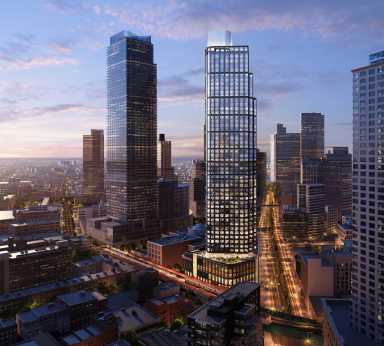
The rapid ascent of a 676-foot residential tower in Queens signals both New York’s tenacity amid housing shortfalls and the high-stakes calculus of urban development in a city still learning to love its own skyline.
On the western edge of Queens, in the no-man’s-land between the rumbling tracks of the 7 train and the glassy towers of Manhattan, something tall and concrete is clawing its way into prominence. At 24-19 Jackson Avenue, cranes now swirl above a skeleton of rebar and concrete slab: construction of what will become Long Island City’s (LIC) latest and loftiest residential skyscraper is officially going vertical.
The new tower—676 feet high, 600 condominiums, and 10,000 square feet of retail—marks a telling tempo for a city desperate for fresh housing supply. Just months ago, the site was dormant, host only to weeds and the ghosts of a failed hotel scheme by Toyoko Inn. Now, the foundation having barely set, perimeter columns are sprouting and multistory work is underway, on track for topping out this spring and full completion pencilled for 2028 or the beginning of 2029.
Few New York stories better distil the city’s uneasy embrace of change. Developers Charney Companies and Tavros Capital, backed by Incoco Capital, spent $68.3 million in 2022 wresting the lot from its former Japanese owner, swapping dreams of yet another cookie-cutter high-rise hotel (originally listed as 1,200 “units,” likely a fudge between housing and hotel rooms) for what they hope will be a destination in its own right. Chelsea Piers Fitness has snapped up a whopping 72,000 square feet in the podium, promising a kind of vertical health club: outdoor pool, running track, basketball, studios, and enough athletic flourish to lure professional types north of Hunters Point.
For the city, the stakes are both immediate and recurring. New York endures one of America’s gravest housing crunches—rental vacancy fell below 2% citywide in 2023, the paltriest figure in decades. Construction starts, battered by high interest rates and recalcitrant permitting bureaucracy, have flagged. In this context, every spade of dirt matters; 600 condominiums cannot, in themselves, tilt the supply–demand balance, but the project bodes well for the battered spirits of the construction sector, cascading through jobs, materials, and (eventually) local taxes.
The skyline of Long Island City has been a source of low-key controversy since the Bloomberg-era rezonings that unlocked swathes of the neighbourhood to luxury towers. Local critics fret about “overdevelopment” and fret further about whom, precisely, these glassy behemoths serve. None of this is unwarranted: the condo market, particularly at the top end, is buoyed by absentee investors, part-time residents, and, by now, a small but irritating glut of empty “investment” units. On the other hand, the spectre of unaffordability is fuelled just as much by stifling supply as by speculative demand; at least half the boroughs would kill for more cranes in the sky.
For all the fuss, LIC’s transformation is neither surprising nor especially novel. Cities from Toronto to Singapore have proved the efficacy—and economic inevitability—of building up. New York, late to its own party, has tended to oscillate between chest-thumping density and preservationist nerves. So it is that the current tower, designed by FXCollaborative, tries to have it both ways: setbacks; podium terraces; black panelled facades that nod (at least on the renderings) to industrial cues. The glass grid, meanwhile, offers the standard trappings of Gotham’s gentrified present.
A vertical wager, and a city’s ambivalence
What, then, does this tower portend for city and society? First, a blunt, possibly unwelcome truth: solving New York’s housing shortage by leaning solely on private capital nearly always yields luxury supply first. With affordable housing mandates stalled or throttled by Albany’s political logjam (the demise of 421a tax incentives comes to mind), buildings such as this one remain, if not the solution, then at least a partial salve. The presence of such investment in outer boroughs at all is, for now, a modest silver lining.
Economically, Long Island City’s continued vertical expansion signals private faith in the city’s fundamentals, even as the drumbeat of urban “doom loops” from across the US office sector persist. Construction still employs some 150,000 New Yorkers annually. The fitness centre’s lease is a small but telling nod: even as Mid- and Uptown’s retail struggles, developers reckon active amenities exert ever more pull on post-pandemic buyers, and not just in Manhattan.
Politically, these new towers are something of a high-wire act. Local officials must balance NIMBY anxieties against mounting pressure for more homes. Densification brings tax revenue and economic churn, but also strains infrastructure—transit, schools, utilities—that too often lags. One can only hope that planners at the Department of City Planning and the MTA, at least, are tallying population forecasts with more than the usual shrug.
Globally, LIC’s arc resembles the vertical booms seen in London’s Docklands or Vancouver’s Coal Harbour—deindustrialising districts reimagined as “global city” outposts. The difference, arguably, lies in the apathy with which New Yorkers still greet such towers. In Asian metropolises, high-rise living is a birthright for the middle class. In New York, it retains the air of a privilege, or, depending on one’s view, a necessary peculiarity.
The economics of housing suggest that what the city needs most is not fewer condos for lawyers but a buoyant stream of supply across the price spectrum—an unglamorous recipe unlikely to flatter either developers’ taste or voters’ nerves. Still, it is better to stack apartments high than sink into inertia. Vertical builds on this scale are cumbersome to design and excruciating to finance. They rely on the optimism of capital and, increasingly, the forbearance of local communities.
New York, to its credit, perseveres. The Jackson Avenue tower will rise, whether beloved or berated, and a patch of wasted land will at last rejoin the city’s economic life. In this, the unyielding vertical logic of population growth finds its surest proof.
As the skyline inches ever higher, New Yorkers would do well to remember that the real luxury is not in the penthouse, but in the prospect of a growing, living city that refuses to run out of room. ■
Based on reporting from QNS; additional analysis and context by Borough Brief.